

Always-on, goal-driven marketing is bigger than an automation upgrade
Always-on, goal-driven marketing means continuously evaluating live customer signals against a defined business goal, and choosing the best next action – including no action – instead of running every customer through a fixed, trigger-based journey.
Many marketing organisations treat always-on marketing as the next stage of automation: more triggers, faster journeys and more personalised messages. In reality, it is closer to an operating-model shift, where goals, customer signals, decisioning, activation and governance need to work as one system.
For marketing leaders, this matters because the change is not only about responding faster. It is about deciding when to act, which action is appropriate, and when the best customer experience is no communication at all.
In this article, we cover:
- Why event-triggered marketing is not the same as goal-driven decisioning
- How Marketing Cloud Next changes the relationship between customer data, journeys and cross-cloud actions
- What organisations need to change in measurement, governance and operating models
- How to start with one valuable customer moment rather than redesigning the entire lifecycle
Why the campaign model is reaching its limit
Campaigns exist for good reasons. They bundle work into something teams can plan, approve, execute and measure. When customer data was fragmented and decisioning was slow, batching people into segments and scheduling communications was the only realistic way to operate at scale.
Those technical constraints shaped the operating model. Marketing calendars became the backbone of execution. Journeys were designed as fixed paths. Segments were refreshed on a schedule. Results were reviewed after enough data had accumulated, often when the opportunity to change the experience had already passed.
The problem is not that the campaign fails to execute. It may perform exactly as designed. The problem is that its assumptions can become outdated after the customer enters the journey.
A customer opens a service case. A product goes out of stock. An opportunity changes stage. Consent is updated in another system. The journey continues unless those signals are available and the logic knows how to respond.
Technical success and customer relevance are not the same thing.
Why this matters right now
Customer expectations and platform capabilities are moving in the same direction. Customers expect brands to recognise recent interactions across marketing, sales, service and commerce. At the same time, leadership expects marketing to contribute to outcomes such as pipeline, retention, margin and customer value, not only campaign activity.
Marketing Cloud Next reflects that shift. It is built on the Salesforce Platform and uses Data 360 as its data foundation, and Salesforce Flow can coordinate actions across clouds.
As of the Winter ’27 release, this is no longer a future direction: Campaign Agent is now generally available inside Marketing Cloud Next. It assembles a campaign, personalises the content per customer, and decides the channel, timing and message for each individual – then keeps adjusting as results come in. It is a live, working example of the decision layer this article is describing, not a roadmap item.
The architectural difference matters. In Marketing Cloud Engagement, a journey often begins with a prepared audience and a channel-specific data structure. In Marketing Cloud Next, the context can include CRM records, service activity, commerce events and external data brought together through Data 360. The next action does not have to be another marketing message. It may be a service process, a sales task or no action at all.
This does not mean Marketing Cloud Engagement stops being useful. Salesforce’s current adoption model allows Engagement and Next to work together. Existing journeys can remain operational while new use cases introduce unified data, Flow-based orchestration and cross-cloud decisions.
That hybrid model is practical, but it still requires design. Identity rules, consent mapping, data latency and ownership do not solve themselves because the platforms are connected. The technical connection may be straightforward. The customer model rarely is.
What always-on, goal-driven marketing looks like
Always-on does not mean always sending. It means the organisation is continuously listening and is ready to make a decision when a relevant customer signal appears.
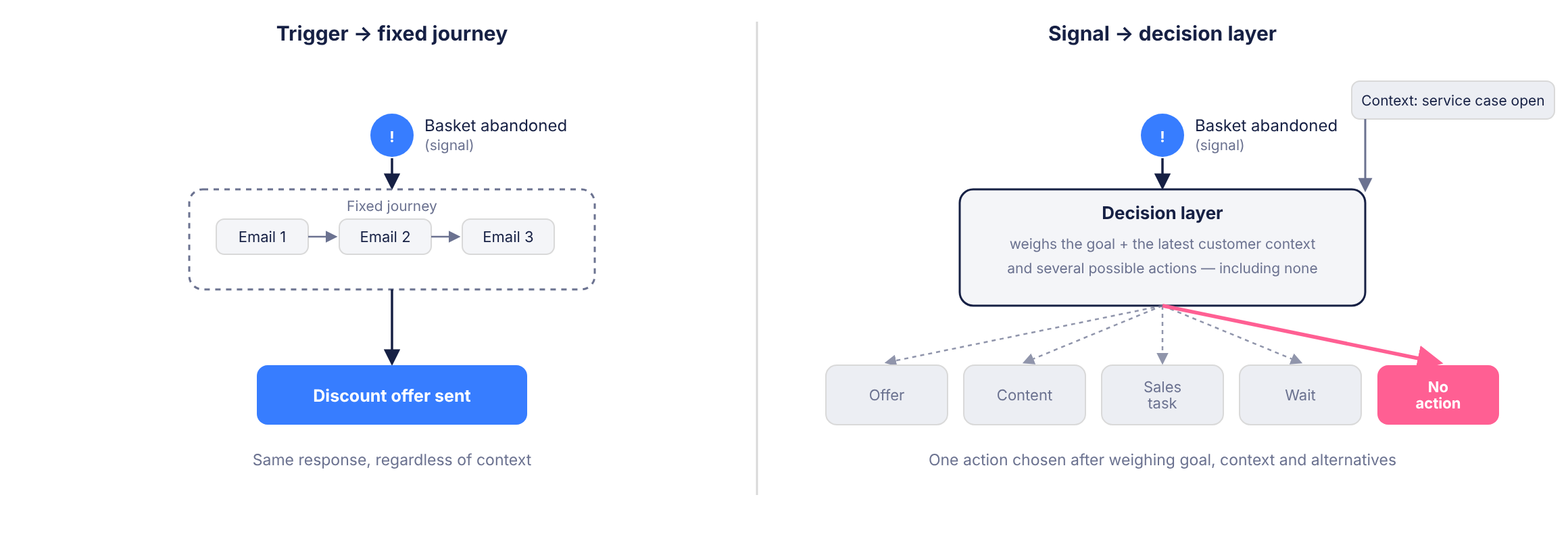
The same signal – a basket abandoned – gets the same discount offer every time in a trigger-based journey. In a goal-driven decision layer, the same signal plus one extra piece of context (an open service case) changes which of several eligible actions gets chosen. Here, no action wins; offer, content, sales task and wait were all considered and set aside.
What Good Looks Like
- A clear business outcome, such as reducing preventable churn or accelerating qualified pipeline
- Customer and business signals with defined meaning, freshness and confidence
- A decision layer that can compare several eligible actions rather than simply start one fixed journey
- Consent, frequency, margin, brand and customer-protection rules applied before optimisation
- Content and offers designed as reusable options rather than one-off campaign assets
- Measurement based on incremental business outcomes, not only sends, clicks and campaign attribution
The goal remains stable, but the treatment can adapt. A customer showing renewal risk may need a reminder, service recovery, a success-manager task, a relevant offer, or no intervention at all. The correct response depends on the reason behind the risk and the latest customer context.
This is more than a larger journey with additional branches. The decision sits above the individual journey and evaluates which action is most appropriate within the boundaries set by the business.
A practical path towards goal-driven marketing
1. Define the outcome and its boundaries
Start with a measurable business goal, not a channel or feature. Define what counts as success, the time horizon, the acceptable cost, and the trade-offs that must be protected. “Increase renewals” is incomplete until the organisation has decided which renewals count, at what margin, and with which customer protections.
2. Design the signals and customer states
Identify the few signals that materially change the correct response. For each signal, document the source, freshness, meaning, expiry and confidence. A page view may be useful as context but too weak to trigger communication on its own. An unresolved complaint may be strong enough to suppress promotion immediately.
3. Separate decisioning from execution
Define the possible actions before choosing the journey. Which actions are eligible for each customer state? Which require approval? What is the fallback when data is missing or contradictory? Existing Marketing Cloud Engagement journeys can continue to execute messages while Marketing Cloud Next, Data 360 and Flow introduce new context and orchestration around them.
4. Change the measurement model
Campaign attribution asks which campaign received credit. Goal-driven marketing asks whether the decision improved the outcome compared with what would otherwise have happened. Establish a baseline, define the outcome window, and use a holdout or control group where possible. Measure suppressed actions and protected margin as well as messages and conversions.
5. Start with one customer moment
Do not begin by redesigning the entire lifecycle. Select one moment where timing and context have measurable value, such as renewal risk, cart abandonment, onboarding, lead follow-up, or recovery after a service issue. Run it alongside the current approach, compare the outcome, and turn the decision logic into a reusable framework for the next use case.
Where organisations often go wrong
-
- Treating always-on as permission to communicate more frequently
- Assuming a real-time trigger is already an intelligent decision
- Connecting every available data source before defining which signals matter
- Optimising one metric without making competing goals and guardrails explicit
- Measuring campaign activity instead of incremental business outcomes
- Giving AI agents broad autonomy before consent, approvals and fallback rules are operational
- Rebuilding every Marketing Cloud Engagement journey before proving a valuable Marketing Cloud Next use case
Atcore Perspective
Atcore helps organisations combine marketing strategy, MarTech, customer data and activation to scale relevant communication and personalisation.
In the move towards always-on, goal-driven marketing, that means helping teams translate business outcomes into customer signals, decision policies, cross-cloud workflows and measurable use cases. It also means being realistic about the hybrid period where Marketing Cloud Engagement remains an important execution engine while Marketing Cloud Next introduces new data, orchestration and agentic capabilities such as Campaign Agent.
The strongest starting point is rarely the largest transformation. It is one well-chosen customer moment, supported by trusted data, clear decision logic, and a measurement model that shows whether the new approach creates real value.
Start with one customer moment
Not the whole lifecycle. Talk to us about mapping the signals and decisions behind your first moment, and we’ll show you what a working example looks like for your business. If you want a structured way to test it on one moment before going further, our Marketing Cloud Next pilot is built for exactly that.
Frequently asked questions
What is always-on, goal-driven marketing?
Always-on, goal-driven marketing is the practice of continuously listening to customer and business signals, and making a decision – not just starting a fixed workflow – every time a signal appears. The decision weighs the business goal, the latest customer context and several possible actions, including taking no action at all.
What is the difference between a marketing trigger and a goal-driven decision?
A trigger only answers one question: when should a workflow start. A goal-driven decision answers a second, more important question: whether that workflow is still the right response for this customer, given everything else known about them right now.
Does Marketing Cloud Next replace Marketing Cloud Engagement?
Not immediately. Salesforce’s current adoption model lets the two work together: existing Marketing Cloud Engagement journeys can keep running while Marketing Cloud Next, Data 360 and Salesforce Flow add unified data, cross-cloud orchestration and agentic capabilities such as Campaign Agent around them.
How do you start with goal-driven marketing without redesigning the whole customer lifecycle?
Pick one customer moment with clear, measurable value — renewal risk, cart abandonment, onboarding, lead follow-up or service recovery are common starting points. Run the new decision logic alongside the current approach, compare outcomes, and turn what works into a reusable framework before moving to the next moment.
Ready to put a decision layer behind your next marketing moment?
Let’s map the signals, actions and guardrails for one high-value customer moment, and show you what always-on, goal-driven marketing looks like in practice.
Related insights:
- Why the move from Marketing Cloud Engagement to Marketing Cloud Next is bigger than a migration
- Why real-time data is not the same as real-time relevance in Salesforce
Sources:
- Salesforce: Introducing the Campaign Agent That Turns Goals Into Growth
- Salesforce: Marketing Cloud Winter ’27 Release: What You Need to Know
- Salesforce: Top Takeaways from Connections 2026
- Salesforce: Why You Need to Let Go of Campaigns and Embrace Always-On Marketing
- Salesforce Trailhead: Get to Know Marketing Cloud Next with Marketing Cloud Engagement
- Salesforce Help: Configure Marketing Cloud Engagement+